

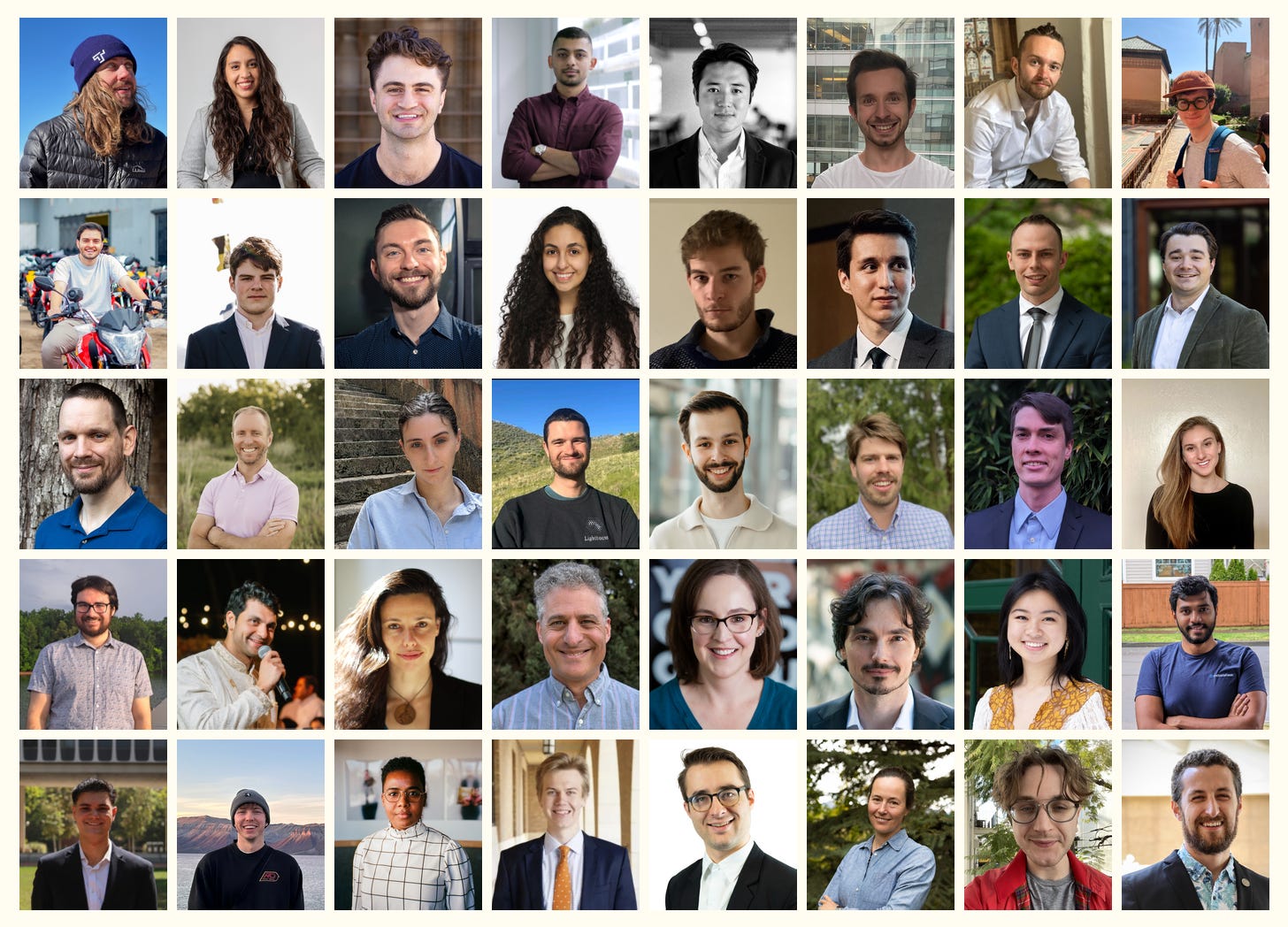
Last week we kicked off our fourth Blog-Building Intensive Fellowship with a cohort of 41 outstanding fellows.
This year’s fellows were selected from a pool of nearly 400 impressive applicants. They include scientists, chip builders, former diplomats, philanthropists, economists, veterans, teachers, policymakers, and two former child actors! They’ll be writing from Europe, China, Kenya, India, and the United States about aging, immigration, manufacturing, housing, Georgism, global development, AI, ecomodernism, public health, educating the next generation of builders, and so much more.
Here are the 2026 Roots of Progress Blog-Building Intensive Fellows:
Aaron Fried is the co-founder and CEO of Akston.ai, a writing tool with AI structured to help writers think rather than produce slop. He writes about how AI can help enhance human creative expression and improve our lives.
Abi Olvera is the founder of DC Abundance and an AI researcher. She has a master’s degree in international relations from Yale and spent 10 years as a foreign service officer with the U.S. State Department. She writes about the politics of abundance..
Adam Rochussen is a postdoctoral research fellow at the Salk Institute for Biological Studies, where he studies T cells, circadian rhythms, and cancer immunotherapy. He writes about science and culture.
Ajwal Dsouza studies plant production in controlled environments. He was a finalist on the Canadian Space Agency’s Deep Space Food Challenge. He writes about the intersection of plant science, technology, and business.
Alex Araki supports research into chronic pain classification and is a former drug hunter at Gordian Biotechnology. He writes about philanthropy and fundraising.
Alex Plesa researches aging at Harvard’s Wyss Institute. He also completed his PhD at Harvard, where he discovered new ways to reverse the age of cells and extend lifespan in mice. He writes about aging research.
Alex Wakeman is an emerging technology research officer for the U.K. Government Office for Science. He completed his PhD in evolutionary biology at the University of Leeds and has written for Asimov Press and Works In Progress.
Alexander Thompson is a tutor of law and philosophy in the United Kingdom. He has a PhD in the history of law from Cambridge University, with a focus on the Industrial Revolution.
Ben Hyman is Operating Partner at the Africa Jobs Fund, a philanthropic investor/venture-builder focused on creating higher-productivity jobs for low-income workers in Africa. He received his BA from the University of Oxford.
Cooper Kramer is an equipment engineer at Tokyo Electron, where he works on semiconductor manufacturing equipment at the Albany (New York) NanoTech Complex. He writes about the business and geopolitics of chips.
Daniel Golliher is the founder of Maximum New York, a school that teaches students inside and outside of New York City how the government works. He writes about governance and civics.
Deena Mousa leads Coefficient Giving‘s grantmaking at the intersection of AI, global health, and economic growth. She has written about these topics for The Economist, Scientific American, and National Geographic, as well as on her Substack.
Farrell Gregory is a non-resident research fellow at the Foundation for American Innovation in Washington, D.C., where he focuses on how America and China build technological power.
Gil Guerra is a senior policy analyst at Hudson Institute, where he researches immigration and foreign policy, migration-related security issues, and immigrant assimilation in the United States.
Inferential Gap is an anonymous Substack author who aims to narrow the inferential gap between the Chinese and Western AI ecosystems.
Jack Despain Zhou is a cultural commentator, law school graduate, and education policy advocate and cofounder of the Center for Educational Progress. He writes about institutional design and educational progress.
Jacob Bruggeman is an incoming assistant professor at the Salmon P. Chase Center for Civics, Culture, and Society at The Ohio State University, where his research examines the entangled histories of technology, politics, and American institutions. He writes about politics and policy.
Lars Doucet is president of data and research at the Center for Land Economics. Previously, he was a video game designer. He writes about Georgism.
Latham Turner is a homeschooling dad working to create an education that allows his kids to advance the frontier of their potential. He writes about education as a human potential problem.
Lauren Teixeira is an analyst at the Breakthrough Institute, an energy-focused think tank. She is interested in compelling stories about why the world is the way it is, and has developed an “obsessive commitment” to hosting parties!
Luke Eure is head of sales at Lighthouse, which helps frontier talent navigate the U.S. immigration system. He holds a BA in physics from MIT and writes about talent-maxxing through immigration.
Marius Drozdzewski is the founder and editor of ævum, a German-language magazine about political ideas, and works at Prometheus, a Berlin-based think tank.
Matthew Gammans is an assistant professor of agricultural policy at North Dakota State University, where he researches how markets, policy, and climate shape the future of agricultural production and the environment. He writes about agriculture economics.
Michael Wiebe is an economist focused on housing. His an independent research and is currently conducting a living literature review for Coefficient Giving. He received his PhD from the University of British Columbia and writes about housing policy.
Morgan Livingston has worked on AI and science policy in the Senate, the White House, and federal agencies, with a focus on how America can both advance and govern risky technologies.
Nick Frassinelli is an electrical engineer, a power systems graduate student at Clemson University, and an all-around energy nerd. He writes about the technical, political, and economic constraints that shape the energy landscape.
Nikhil Davar helps run the recruiting arm of The Diff. He writes about how can we use machine intelligence to better select for, develop and reach the human intelligence
Olya Irzak is the founder and CEO of Frost Methane Labs and a co-founder of Diamond List, which publishes an annual list of climate startups that have been nominated by qualified climate investors.
Oren Hadar is an urbanist based in Los Angeles. He writes about making Southern California more affordable.
Pamela Hobart is the gifted education advocate in residence at GT School. Previously, she studied the philosophy of education and education policy at Teachers College, Columbia University. She writes about academic acceleration..
Patrick Mineault funds frontier neuroscience and AI research at the Amaranth Foundation. Previously, he worked on the Brain-Computer Interface team at Facebook. He writes about AI and neuroscience.
Peggy Yin is a PhD student at Stanford, director of the Cognitive Security Task Force, and a board member at LearnerStudio. She designs and studies transformative experiences, particularly in education and workforce development.
Rohit Shinde is a senior software engineer at The Trade Desk. He received his master’s in computer science from Rutgers University and writes about development in India.
Ryan Alimento is a clean energy analyst at the Breakthrough Institute. He received his bachelor’s in chemical engineering and master’s in green technology from the University of Southern California.
Ryder Kimball is a climate tech writer at Lowercarbon Capital and a landscape photographer. He previously worked on the comms team for Planet, a satellite data provider, and Pacific Fusion, a nuclear fusion startup.
Salma Abdalla is a professor of population health research at Washington University in St. Louis. She received her medical degree from the University of Khartoum and completed a PhD in public health at Boston University. She writes about public health and progress.
Sam Roland is a nonresident fellow at the Foundation for American Innovation and a law student at George Mason University Antonin Scalia School of Law, where he is also founder and president of the Scalia AI Law Society. He writes about regulation and progress.
Samuel Scheuer is a graduate analyst at Aurora Energy Research. He received his master’s in environmental change and management at Oxford University, and writes about energy policy.
Sophie Gilbert is a senior researcher at the Property and Environment Research Center. She completed her PhD in wildlife biology at the University of Alaska Fairbanks, and blogs about conservation and abundance.
Thomas Briggs is director of operations at the Center for Educational Progress. He received his JD from the University of California, Los Angeles.
Trey Gordner is a policy researcher and data scientist at the University of Hawaii Economic Research Organization, where he works on housing affordability. He writes about municipal charter reform.
Very excited to be a part of this cohort!
Awesome set of writers. Can’t wait to see what they publish