

Starting June 15th, the Roots of Progress team brought together 30 teenagers to learn about Progress in Medicine. These talented, ambitious high schoolers are choosing to spend six weeks of their summer exploring careers in medicine, biotech, and health as part of the inaugural cohort of the Roots of Progress summer career exploration program.
We launched Progress in Medicine (PiM) in December as a test, a pilot program aimed at answering the question: How can we inspire young people to choose builder careers that advance human progress?
Our hypothesis when we designed PiM was this: Schools generally are ill-equipped to help teens figure out their life purpose—and teens and parents feel this problem urgently enough that they are willing to invest time and money. While many other great summer programs exist, none offered what we would have wanted for our own teens: a hybrid model that enabled teens to go deep on content and community building, without requiring them to commit their entire summer to one camp. Plus, few selective programs go broad: many competitive, ambitious programs zero in on one specialty, rather than helping teens explore a wide range of careers to see where they might fit. We thought teens needed to learn not just the what of a specific discipline, but get the framework of the why and how. That means learning the story of historical progress in medicine and bio, including the people who made it happen. It also means meeting the people on the current frontiers, and learning where they as young people can build a career that matters.
This is what Progress in Medicine set out to do, and now that the program has started, we’re even more excited about its potential to solve a real parent-student problem and have meaningful impact on the broader world.
Without much marketing (one ad in an online summer camp listing space, plus a couple of emails to organizations like HOSA, a health care network for young people, plus our own network), we received well over 100 applications. The 30 students, ages 14–18, who we admitted in this inaugural class come from all over the US, Canada, and four international countries. Some are interested in becoming neurosurgeons, pediatricians, cancer researchers, and biomedical engineers; others are just curious about medicine and eager to figure out where they might fit. Some are already medical builders, launching an app with 10,000 users or putting together business plans for moonshot ideas; others have built in other areas (AI tools, computers, robots); and others have volunteered or had challenging summer jobs.
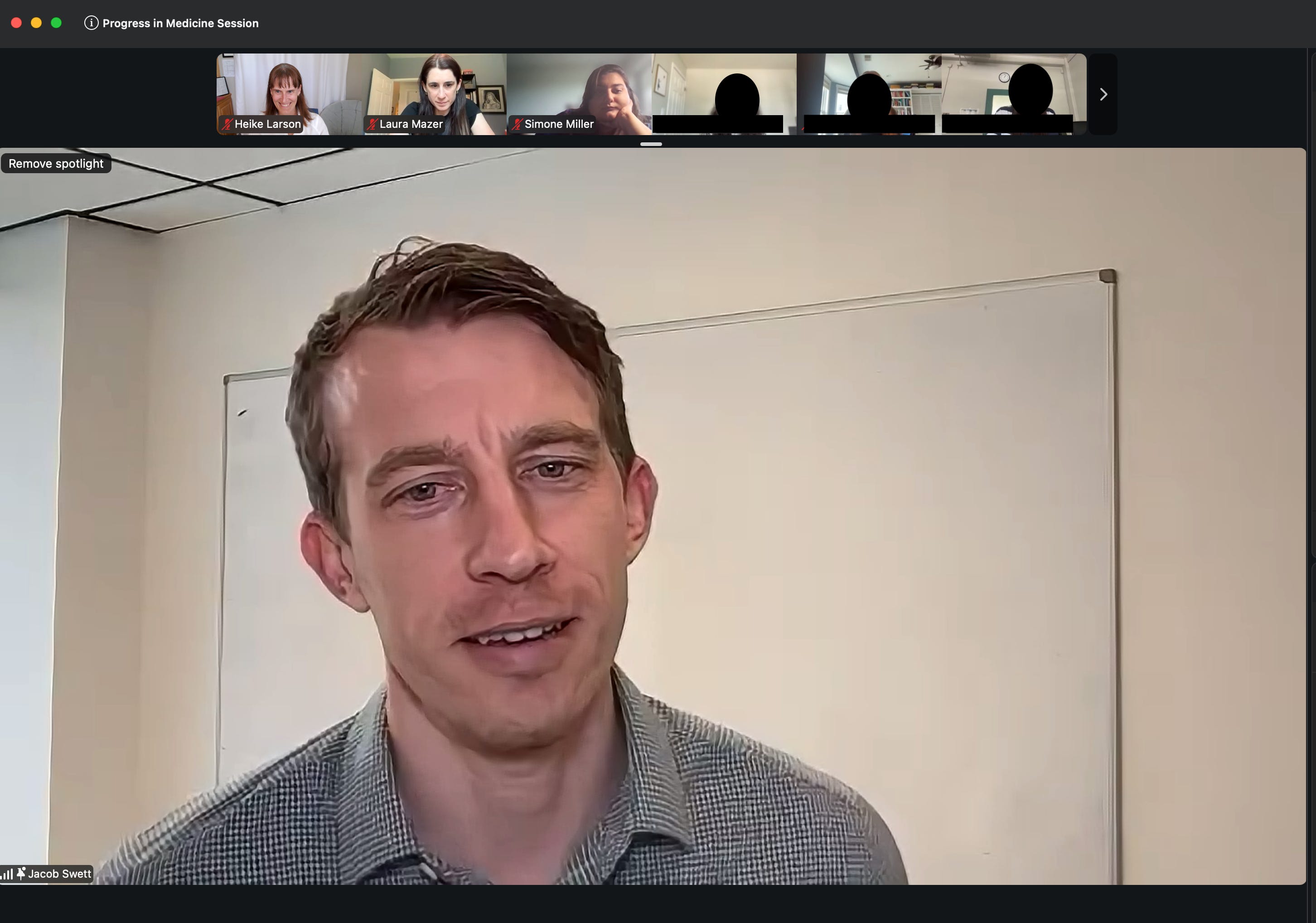
This week showed us that we selected well. We had great (on-time, camera-on!) attendance in our four two-hour long Zoom sessions. Teens maxed out their break-out room chats, completed their online assignments, and flooded our Zoom chat with their answers. For our first advisor session on sanitation, 22 of our students asked a wide range of questions of Dr. Jake Swett, Executive Director and founder of Blueprint Biosecurity—and their questions showed how deeply many had researched Dr. Swett and his company.
The Progress in Medicine program is led by Laura Mazer, a Stanford-trained surgeon turned educator, who writes about the history of Medicine on Substack. PiM has three parts:
Four online weeks, two hours per day. Teens learn about the history of medicine and bio via case studies (sanitation, infectious diseases, cancer, research ethics, obesity, longevity). They meet with expert advisors and ask them questions. They learn life skills—such as how to be a good mentee and get the most out of mentors. They then apply those skills, for example, by meeting in small groups with young professionals who have agreed to be near-peer mentors.
A four-day in-person residency at Stanford. Teens will tour university facilities and labs, as well as Bay-Area biotech companies. They’ll gather for a celebratory reception at The Institute at Salesforce Tower, where they’ll meet with inspiring adults involved in medicine and biotech, and the broader Bay Area progress movement. They’ll get to experience dorm life and meet Stanford students, and spend time with each other to deepen their relationships.
A reflection and writing week. Back home and online, teens will write up what they learned. With guidance by our on-staff editor, Mike Riggs, they’ll synthesize their insights about the world of medicine, biotech, and health, and their growing awareness of their own interests into a personal narrative which can form the basis for a college application essay.
When we launched this program we had two big questions:
Are teens and parents eager to explore careers through a wider, progress-oriented lens?
Can we help raise ambitions and broaden perspectives of talented teens in a way that empowers them to choose great-fit careers that tackle some of humanity’s biggest challenges?
We won’t have the full answers for a few more weeks, as PiM runs through late July. But we do know this: 30 teens and their parents are in the program. Two-thirds of the families have paid $2,000 to participate, and one-third of the students attend on scholarships. We’re grateful to our donors who funded the scholarships (without asking for name recognition): your generous donations enabled us to make admissions decisions need-blind, and give these teens a unique summer opportunity.
This summer, we will learn a lot. If Progress in Medicine ends up being the success we now think it can be, it’s a first step in a larger program to help orient teens toward a solutionist mindset and toward builder careers that fill their lives with meaning and contribute toward a better future for all of us. Stay tuned: we’ll have lots of plans to build on this first pilot program!
For now, join us in congratulating these teens on a great first week. We’re excited for the next five weeks we get to spend with them, and can’t wait to meet them in person during the Stanford in-residency in mid-July!
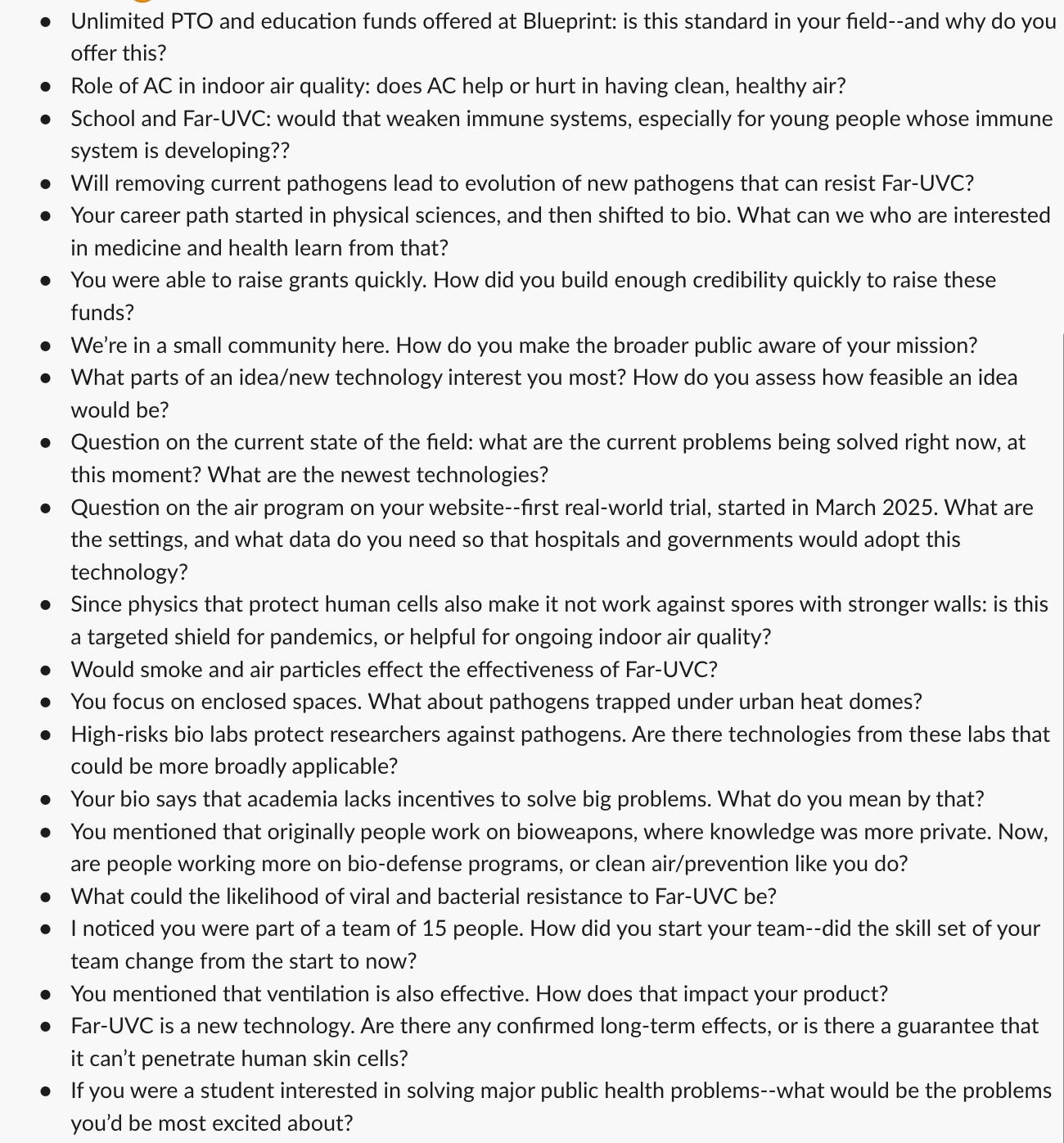
Questions the students asked of Dr. Swett. They were more insightful and better researched than the questions we’ve heard at many adult conferences!
For a Swarthmore freshman course, I suggested three week rotations (one each for humanities, social science, natural sciences). Students ask a question important to them of 3 different AI programs and assess responses. Second week refine and ask better questions of the 3 programs & assess strengths and limits. Third week, ask each AI to develop research proposal to advance evidence-based response. Then repeat cycle. Students evaluated by queries sophistication rather than their responses. Mirrors how students can use AI. Learn that AIs are not god, give different and variable answers, better prompts produce better answers, students start out as Socrates, asking their own questions, rather than Prof as Socrates, AI reviews existing knowledge. Turns education on its head. Students don’t wait until PhD to investigate.